Danish Design Center
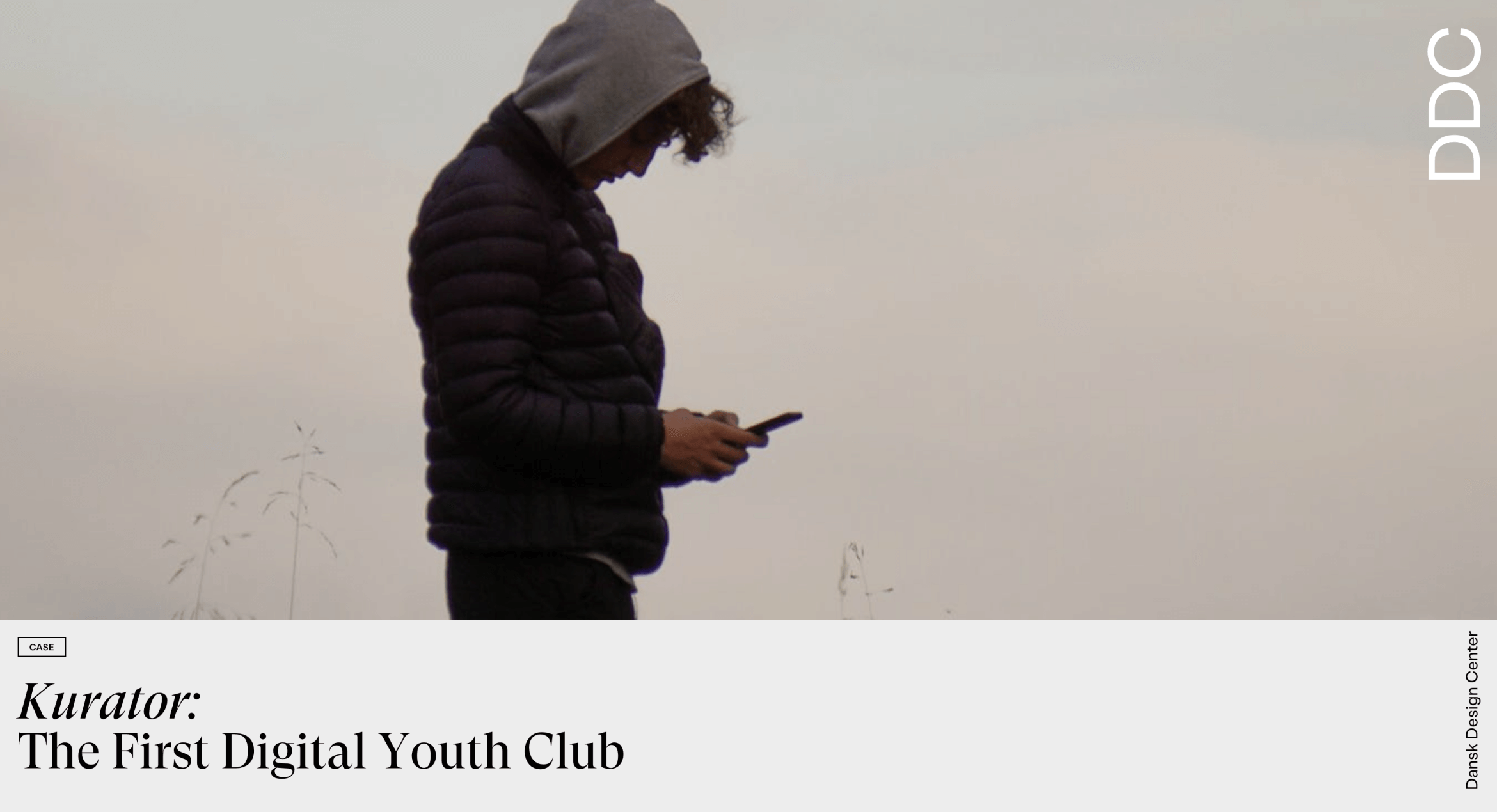
Kurator: The First Digital Youth Club
2023
2023
2023
Year 2023
Year 2023
Insights, Copy, Content
Insights, Copy, Content
Insights, Copy, Content
Type Insights, Copy, Content
Type Insights, Copy, Content
Danish Design Center is a mission-driven innovation lab that expands the design field and tackles select societal challenges by producing new and accessible knowledge to drive sustainable growth.
I wrote this case study to show decision-makers at social foundations and public institutions what can happen when design meets social innovation, and how DDC tackles complex challenges, such as young people’s mental well-being, through strategic design.
Young people spend a lot of time online, even when hanging out with one another in youth clubs. Still, they crave in-person connection and are aware of how much time they devote to their screens. They consume tons of content but create very little themselves, adding fuel to the fire that is the creativity crisis. And the youth club staff? They’re puzzled.
Kurator revolved around relations. A project conceived in collaboration with KBH+ Askovfonden, focused on building cross-generational understanding and engagement by demystifying the digital realm for the youth club staff.
Danish Design Center is a mission-driven innovation lab that expands the design field and tackles select societal challenges by producing new and accessible knowledge to drive sustainable growth.
I wrote this case study to show decision-makers at social foundations and public institutions what can happen when design meets social innovation, and how DDC tackles complex challenges, such as young people’s mental well-being, through strategic design.
Young people spend a lot of time online, even when hanging out with one another in youth clubs. Still, they crave in-person connection and are aware of how much time they devote to their screens. They consume tons of content but create very little themselves, adding fuel to the fire that is the creativity crisis. And the youth club staff? They’re puzzled.
Kurator revolved around relations. A project conceived in collaboration with KBH+ Askovfonden, focused on building cross-generational understanding and engagement by demystifying the digital realm for the youth club staff.
Danish Design Center is a mission-driven innovation lab that expands the design field and tackles select societal challenges by producing new and accessible knowledge to drive sustainable growth.
I wrote this case study to show decision-makers at social foundations and public institutions what can happen when design meets social innovation, and how DDC tackles complex challenges, such as young people’s mental well-being, through strategic design.
Young people spend a lot of time online, even when hanging out with one another in youth clubs. Still, they crave in-person connection and are aware of how much time they devote to their screens. They consume tons of content but create very little themselves, adding fuel to the fire that is the creativity crisis. And the youth club staff? They’re puzzled.
Kurator revolved around relations. A project conceived in collaboration with KBH+ Askovfonden, focused on building cross-generational understanding and engagement by demystifying the digital realm for the youth club staff.
Danish Design Center is a mission-driven innovation lab that expands the design field and tackles select societal challenges by producing new and accessible knowledge to drive sustainable growth.
I wrote this case study to show decision-makers at social foundations and public institutions what can happen when design meets social innovation, and how DDC tackles complex challenges, such as young people’s mental well-being, through strategic design.
Young people spend a lot of time online, even when hanging out with one another in youth clubs. Still, they crave in-person connection and are aware of how much time they devote to their screens. They consume tons of content but create very little themselves, adding fuel to the fire that is the creativity crisis. And the youth club staff? They’re puzzled.
Kurator revolved around relations. A project conceived in collaboration with KBH+ Askovfonden, focused on building cross-generational understanding and engagement by demystifying the digital realm for the youth club staff.
Danish Design Center is a mission-driven innovation lab that expands the design field and tackles select societal challenges by producing new and accessible knowledge to drive sustainable growth.
I wrote this case study to show decision-makers at social foundations and public institutions what can happen when design meets social innovation, and how DDC tackles complex challenges, such as young people’s mental well-being, through strategic design.
Young people spend a lot of time online, even when hanging out with one another in youth clubs. Still, they crave in-person connection and are aware of how much time they devote to their screens. They consume tons of content but create very little themselves, adding fuel to the fire that is the creativity crisis. And the youth club staff? They’re puzzled.
Kurator revolved around relations. A project conceived in collaboration with KBH+ Askovfonden, focused on building cross-generational understanding and engagement by demystifying the digital realm for the youth club staff.
Case Study Content
Case Study Content
Case Study Content
Case Study Content
Case Study Content
Kurator:
The First Digital Youth Club
How might we support the well-being of young people digitally?
As the digital and analog worlds merge and Gen Z spends more time online than ever, youth club workers find it increasingly more difficult to comprehend the full picture of the universe in which young people live.
Through design-driven workshops, we’ve uncovered six insights and nine recommendations to guide further explorations.
On June 9, 2022, The Children and Youth Administration of Copenhagen commenced a wave of initiatives to improve the youth clubs of Copenhagen.
We partnered up with KBH+ AskovFonden in our project Kurator to shed light on the young peoples’ needs and wishes, to surface insights about what constitutes a good community for them, and to help the youth club workers understand and navigate the digital world.
According to The Danish Center for Social Science Research, VIVE, young people in Denmark spend less and less physical time with one another. Furthermore, the Youth Analysis 2023 conducted by The Danish Youth Council concludes that young people spend more and more time on digital platforms. However, the analysis also concludes that 73 percent of the young participants rate close relations as the single most important aspect of leading a good life.
This led us to ask: how might we translate the value created by the youth clubs onto a digital counterpart?
The Results: 6 Insights, 9 Recommendations
By facilitating design-driven workshops, we gave the young people a voice. In doing so, we uncovered six valuable insights, and to guide any future prototypes and further explorations, we put together nine recommendations.
As we set sail, the youth clubs helped recruit participants for the interviews and the workshops, ensuring adequate representation of the young peoples’ various interests, motivations, and backgrounds.
From these workshops and interviews, we found six insights:
- The young people find the relation to the workers to be paramount.
- The young people don’t recognize the value of a digital youth club — yet.
- The young people are very aware of their screen time. But, when they consume content driven by their interests, they have trouble moderating their screen time.
- The young people are cognizant of what content they’re presented with but less cognizant about what mechanisms operate under the surface.
- The young people are more likely to share content in smaller and closed-off online communities and prefer being anonymous in larger online communities.
- The young people prefer consuming content rather than creating content.
Equally as important, we put the insights into action by recommending how to proceed from here:
- Establish the digital youth club on an existing platform.
- Emphasize building trust in the digital youth club by bridging the gap between the digital and analog worlds.
- Make it possible to participate in interest-driven communities in open and closed spaces.
- Repost and curate content to make young people contribute to the platform.
- Create content with the purpose of establishing a direct line of communication between the youth club workers and the young people.
- Focus on fostering excitement and motivation among the workers.
- Strengthen the workers’ digital knowledge and skills.
- Cultivate reflection and comprehension around digital ethics with young people.
- Keep exploring the value of a digital youth club in collaboration with young people.
The Challenge: Making the Digital World Valuable
As the digital world becomes equally as important as the analog, how might we ensure that the digital world adds value to young people’s day-to-day life and supports them in their transition into adulthood?
A complex challenge, undoubtedly. In order to not bite off more than we could chew, we broke the challenge into bite-sized chunks.
First, we framed the problem; then, we shed light on the young people’s needs and wishes by uncovering what type of content they engaged with; and lastly, we explored what the digital youth club might look like.
To tie up any loose ends, we wanted to round things off with a set of actionable next steps.
Our design process was guided by the questions below:
- How might we strengthen and guide young people in their transition into adulthood through a digital universe?
- How might we establish a digital universe where young people empathize with one another?
- How might we translate pedagogical principles to a digital universe? And which new channels might lead the pedagogical work into the digital arena?
"We know and can see design as a strong power and force in solving complex challenges. The core of the design approach is a deep empathy and understanding of the human factor in how we build products and services. This is a synergy shared with the project and its partners." — Kimmie Tentschert, Senior Creative & Project Manager
The How: Workshops & Interviews
To develop a solid understanding of the young people’s digital habits and everyday lives, we facilitated design-driven workshops and conducted interviews with them on their home turf.
The first order in creating lasting and meaningful impact is to understand the needs and wishes of the people whose lives will be impacted. We facilitated two design-driven workshops with 29 young participants from seven youth clubs to achieve this.
Additionally, we conducted nine interviews, some with individuals and some with groups of 2-4 participants. In total, we interviewed 26 young people between the ages of 14 and 17.
Were we to continue Kurator, we would establish a learning mechanism revolving around The Digital Ethics Compass to build capacity with youth club workers, a continuous learning loop expanding the workers’ ability to understand and navigate the digital world, and for the project to learn from their pedagogical knowledge.
Thus, co-creating the digital youth club alongside the involved parties through further design-driven workshops tailored to the purpose.